HYDROGEN TECHNOLOGIES.
EFFICIENTLY PRODUCED.
The FC³ – Fuel Cell Conference Chemnitz 2026 serves as a premier platform for scientific exchange on fuel cell and hydrogen technologies, uniting international researchers and industry pioneers to present the latest findings and technological advancements.The conference will feature over 60 high-level presentations, an engaging poster exhibition and a festive conference dinner.
Don’t miss this opportunity to exchange ideas directly with leading international experts in the field – save the date now!
Download our flyer here: FC3 2026 RegisterNow
Our Keynote Speakers
Haruhito Mori, Junior Corporate Officer, HORIBA Ltd.
Ralph Müller, Spokesperson for Technology and Light Commercial Vehicles, Toyota Deutschland GmbH
Christian von Olshausen, Chief Technology Officer, Sunfire SE
Karl Lötsch, CEO HZwo e. V.
In-depth insights: our topics
 H2 production: Electrolyzers, components, balance-of-plant, materials, simulation models, test methods, innovative production processes
H2 storage and transport: Mobile and stationary storage, distribution systems, logistics, hydrogen compression, refueling, safety
H2 applications: fuel cells, components, balance-of-plant, materials, vehicle drives, stationary applications, simulation models, test methods
Production and scaling: production processes and systems, (series) manufacturing technologies, automation, factory and process planning
Networking: Make valuable contacts!
09.11.2026 PRE-EVENT – HZWO SCIENCE ROUND TABLE – OBERDECK CHEMNITZ
 Start your FC3 Conference experience the evening before the conference with an informal networking reception. Meet fellow participants, reconnect with colleagues, and make new contacts in a relaxed atmosphere above the rooftops of Chemnitz. Enjoy excellent food, refreshing drinks, and the opportunity to exchange ideas before the conference officially begins.
10.11.2026 CONFERENCE DINNER – INDUSTRIEMUSEUM CHEMNITZ

Make valuable contacts during our social programme.
This event is included in the conference ticket.
Further information will follow shortly.
Contact
Kristin Lötsch
+49 160 99 65 98 90
Subject to change without notice!
Start your FC3 Conference experience the evening before the conference with an informal networking reception.
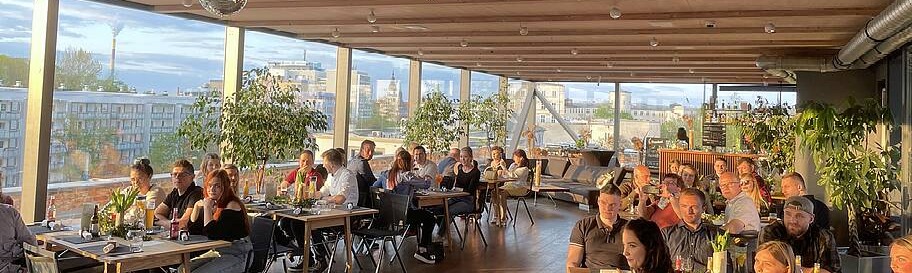
Meet fellow participants, reconnect with colleagues, and make new contacts in a relaxed atmosphere above the rooftops of Chemnitz. Enjoy excellent food, refreshing drinks, and the opportunity to exchange ideas before the conference officially begins.
Please note: Attendance is optional. This is a self-pay event: all food and beverages must be ordered and paid for individually by each participant. The reception is organised as an informal networking opportunity and is not a hosted dinner.
Day 1: 10 November 2026
09:00–10:00 Registration at Carlowitz Congresscenter
10:00–12:00 Opening and Keynotes
Greeting
Univ.-Prof. Dr.-Ing. Thomas von Unwerth - Chairman of the HZwo Board | Head of the Institute for Automotive Research, Chemnitz University of Technology
Univ.-Prof. Dr.-Ing. Welf-Guntram Drossel - First Vice Chairman of the HZwo Board | Executive Director of Fraunhofer Institute for Machine Tool and Forming Technology IWU
Keynotes
The role of Hydrogen toward decarbonization
Haruhito Mori - Junior Corporate Officer, HORIBA Ltd.
Multi-Pathway & Hydrogen Solutions
Ralph Müller - Spokesperson for Technology and Light Commercial Vehicles, Toyota Deutschland GmbH
Electrolysis: Europe’s Strategic Path to Resilience and Competitiveness
Christian von Olshausen - Chief Technology Officer, Sunfire SE
"Made in Europe" starts with Research − Connecting Hydrogen Innovation to Global Markets
Karl Lötsch - CEO HZwo e. V.
12:00–13:00 Lunch Break
13:00–14:30 Presentations Session 1
| 13:00–13:25
3D Modelling of Alkaline Water and Proton Exchange Membrane Electrolyzers: A Comparative Safety-Oriented Sensitivity Analysis for Hydrogen Production Marilia Gabriela Justino Vaz, AVL Deutschland GmbH |
| 13:25–13:50
Testing the Applicability of Highly Filled Polymer Compound-Based Bipolar Plates in Proton as Well as Anion Exchange Membrane Water Electrolysis Elisabeth Verweyen, ZBT – the Hydrogen and Fuel Cell Center |
| 13:50–14:15
Overcoming the Drawbacks of Classical Alkaline Electrolysis: Towards High Pressure High Temperature Operation Dr. Gregor Zwaschka, Fraunhofer Institute for Machine Tools and Forming Technology IWU |
| 13:00–13:20
Hydrogen storage and electric drive functional solution for heavy fuel cell-powered mobile machinery Norbert Schramm, LSE GmbH |
| 13:20–13:40
Deep Reinforcement Learning for Hydrogen Hybrid Train Energy Management using Track Preview and Curriculum Learning Ziqi Chen, Chemnitz University of Technology |
| 13:40–14:00
HY.COMM – Clean Hydrogen Construction and Mining Machine Dr. Martin Ufert, Fraunhofer Institute for Transportation and Infrastructure Systems IVI |
| 14:00–14.20
Impact of Current Ripples on PEM Fuel Cell Aging Osvaldo Daniel Mutuque, INP Toulouse, Laplace Laboratory, FR |
| 13:00–13:20
Industrial Scale Production of Membrane Electrode Assemblies for Fuel Cells and Electrolysis Ulf Groos, Fraunhofer Institute for Solar Energy Systems ISE |
| 13:20–13:40
Reduction of Critical Raw Materials in Catalyst Coated Membranes Dr. Rameshwori Loukrakpam Jalan, Dinex Deutschland GmbH |
| 13:40–14:00
Numerically Efficient Approach to Chemical Degradation of PFSA membranes in PEM Fuel Cells Samuele Cappelli, HyCentA Research GmbH |
| 14:00–14:20
Recent Developments in Inkjet Printed Iridium Catalyst Layers for PEM Water Electrolysis Frank Siegel, Fraunhofer Institute for Electronic Nano Systems ENAS |
14:30–15:15 Coffee Break
15:15–16:30 Presentations Session 2
| 15:15–15:40
Fast Impedance Spectroscopy: A Probabilistic Diagnostics Approach Pavle Boškoski, Jožef Stefan Institute, SI |
| 15:40–16:05
Methodological Challenges in the Experimental Assessment of Trace Gas Contamination Effects on LT-PEM Fuel Cell Lifetime Christian Heßke, Zentrum für BrennstoffzellenTechnik GmbH |
| 16:05–16:30
Reversible Phenomena Within Low-Temperature PEM Fuel Cells: State of the Art, Feedback, Reflections and Suggestions Dr.-Ing. Christophe Turpin, CNRS / Laplace, FR |
| 15:15–15:40
Investigation on Heavy Duty Fuel Cell module with novel Electric Air Compressor with Recuperation (AC+eR) Erik Pohl, Chemnitz University of Technology |
| 15:40–16:05
Model-Based Estimation of Air Mass Flow and Pressure in a Multi-Stack Fuel Cell System Markus Schorr, German Aerospace Center (DLR) |
| 16:05–16:30
Experimental and Modeling Framework for Efficient Development of Fuel Cell Systems Dr. Katharina Braun, Friedrich-Alexander-Universität Erlangen-Nürnberg |
| 15:15–15:40
Bridging Multi-Vendor Heterogeneity in Fuel Cell Mass Production: A Simulations-Based Decision Support framework to Facility Design and Optimization Omid Safari, Fraunhofer Institute for Machine Tools and Forming Technology IWU |
| 15:40–16:05
Coating Strategies for Compound Bipolar Plates Based on Titanium and Titanium Powders Prasad Venkatesan, Whitecell Eisenhuth GmbH and Co. KG |
| 16:05–16:30
Ultrathin Composite Bipolar Plates for PEM Fuel Cells: Application Potential, Development Challenges and Optimization Strategies for Mechanical Reinforcement Dr.-Ing. Laura Huwald, Fraunhofer Institute for Environmental, Safety and Energy Technology UMSICHT |
18:30–23:00 Conference Dinner at Industriemuseum Chemnitz
Registration: 18:00–18:30
Day 2: 11 November 2026
08:00–09:00 Registration at Carlowitz Congresscenter
09:00–10:30 Presentations Session 3
| 09:00–09:18
Seasonal Hydrogen Storage Based on the Acetone-Isopropanol Couple George Pätzold, HI ERN - Helmholtz-Institut Erlangen-Nürnberg für Erneuerbare Energien |
| 09:18–09:36
Technology Comparison for PEM-based and SOC-based Seasonal Hydrogen Storage Systems Prof. Dr.-Ing. Laura Nousch, Hochschule für Technik und Wirtschaft |
| 09:36–09:54
Sol-Gel Barrier Coatings for Hydrogen Permeation Reduction in High-Pressure Storage Systems Dr. Justyna Krzak, Wrocław University of Science and Technology, PL |
| 09:54–10:12
Development of Frame-Integrated, Cost-Efficient Hydrogen Pressure Vessels for Micromobility Solutions Max Kreter, Hochschule Mittweida |
| 10:12–10:30
CladPipe4H2 – Combined roll forming and induction welding of explosively clad sheets for hydrogen transport Murli Manohar Pandey, Chemnitz University of Technology |
| 09:00–09:20
Maximizing Pt utilization: Functionally Graded Cathodes in PEMFCs Prof. Dr.-Ing. Karel Bouzek, University of Chemistry and Technology Prague, CZ |
| 09:20–09:40
Beyond PFSA: Unlocking SPPS-Based Catalyst-Coated Membranes for PEM Fuel Cells Lionel Talley Fogang, Center for Solar Energy and Hydrogen Research Baden-Württemberg (ZSW) |
| 09:40–10:00
Comparative Analysis of Layer Uniformity in PEMFC Electrodes Fabricated by Different Deposition Methods Martina Iaia, University of Modena and Reggio Emilio, IT |
| 10:00–10:20
Impact of Swelling and Drying Behavior on Crack Formation of Catalyst Coated Membranes for Fuel Cells Alexandra Decker, Karlsruhe Institute of Technology (KIT) |
| 09:00–09:20
Efficient Simulation Tools and Methods to Model the Structural Behaviour of Complete Fuel Cell Stacks Under Various Load Cases Jörg Evertz, Tribecraft AG |
| 09:20–09:40
A Model-Based Design and Experimental Validation of an Ejector for Anode Recirculation in a PEMFC System: Dynamic Performance Analysis of Passive, Active, and Hybrid Strategies Philipp Rathke, Chemnitz University of Technology |
| 09:40–10:00
Integrated Fuzzy Logic and Degradation-Aware Energy Management for PEM Fuel Cell Hybrid Electric Vehicles Rico Löser, Fraunhofer Institute for Machine Tools and Forming Technology IWU |
| 10:00–10:20
Thermodynamic Modelling and Simulation of Liquid Hydrogen Refuelling: A Modular Simulation Tool Thomas Stadlbauer, HyCentA Research GmbH |
10:30–11:15 Coffee Break
11:15–12:45 Presentations Session 4
| 11:15–11:35
Hierarchical Energy Management for Hydrogen Drones Michael Hauck, Chemnitz University of Technology |
| 11:35–11:55
Highly Integrated Hydrogen-Based UAS Concepts for Increasing Range and Operational Duration Henning Schröder, move technology GmbH | Marc Neubert, LSE GmbH |
| 11:55–12:15
Hydrogen-Powered UAVs for Resilient Critical Infrastructure: Technologies, Challenges and Future Applications Dr. Arkadiusz Zurek, Wroclaw University of Science and Technology / LOGdrone GmbH |
| 12:15–12:35
Hybrid Electric Propulsion with Solid Oxide Fuel Cells: Thermodynamic Potentials and Challenges Pascal Köhler, Leibniz University Hannover |
| 11:15–11:35
Bipolar Plates – Design for circular economy easing automated assembly and disassembly Prof. Dr.-Ing. Dennis Backofen, Fraunhofer Institute of Machine Tools and Forming Technology IWU |
| 11:35–11:55
Hydrogen Circular Economy: Methodology Toolkit for Fuel Cell and Electrolyzer Recycling René Schmiedel, Chemnitz University of Technology |
| 11:55–12:15
Post-processing of Continuously Produced Ultrathin Composite Bipolar Plates: Roller Embossing Felix Lohaus, Fraunhofer Institute for Environmental, Safety and Energy Technology UMSICHT |
| 12:15–12:35
Low Energy Electron Beam Treatment of Polymer Compounds for Improved Material Characteristics in Fuel Cell and Electrolyzer Applications Dr.-Ing. Stefan Saager, Fraunhofer Institute for Electron Beam and Plasma Technology FEP |
| 11:15–11:40
Formability and Corrosion Performance of Nickel-Free Ferritic Stainless Steel for PEM Water Electrolyzer Bipolar Plates Sebastian Porstmann, Fraunhofer Institute for Machine Tools and Forming Technology IWU |
| 11:40–12:05
Fast-Prototyping: Prototype production of metallic bipolar plates using series technologies Dr. Robert Laue, SITEC Industrietechnologie GmbH |
| 12:05–12:30
Development of a Cylindrical Rolled PEM Fuel Cell Concept (ROLL‑FC) for Modular Fuel‑Cell Systems Dr.-Ing. Nico Keller, Chemnitz University of Technology |
12:45–14:00 Lunch Break and Poster Session
14:00–15:30 Presentations Session 5
| 14:00–14:20
Experimental Validation of a 1D System Model of a Single-Cell PEM Electrolyzer Dr. Jan Novotny, Jan Evangelista Purkyně University in Ústí nad Labem, CZ |
| 14.20–14:40
Predevelopement and Evalution of a Tool for Automated Performance and Degradation Analyses in Real PEM Electrolysis Systems During Operation Simon Stöckl, Ostbayerische Technische Hochschule Regensburg |
| 14:40–15:00
A Structured Methodology for Determining Specific Energy Consumption of Electrolyzers DI Dr. Daniel Ritzberger, AVL List GmbH |
| 15:00–15:20
Water Contamination in PEM Electrolysis: Ion Uptake and Conduction Inside the Membrane Critically Influence Efficiency Roman Leskau, Fraunhofer Institut für Werkzeugmaschinen und Umformtechnik IWU |
| 14:00–14:20
Physics-Consistent and Robust Causal Discovery Framework for PEMFCs Using PCMCI+ Thanuj Singaravelan, Fraunhofer Institute for Transportation and Infrastructure Systems IVI |
| 14:20–14:40
Monitoring the Health State of a Fuel Cell Using Magneto-Tomography Dr. Antony Plait, Université de Toulouse, Toulouse INP, CNRS, LAPLACE, FR |
| 14:40–15:00
Integrated Condensate Measurement and Raman Spectroscopy for Water Mass Balancing of PEM Fuel Cells Johanna Lützenkirchen, Friedrich-Alexander-Universität Erlangen-Nürnberg |
| 15:00–15:20
Development and Validation of a Sensor Concept Conceived to Measure Hydrogen Concentration Under Fuel Cell Operating Conditions Lucas Viriato, Chemnitz University of Technology |
| 14:00–14:20
Fuel Cell Backup Power in Critical Infrastructure – Already a Decade in the Field Benedikt Eska, Axiosus Energy GmbH |
| 14:20–14:40
Sizing Trade-offs of PV–Battery–Hydrogen Microgrids for SMEs under Fixed Import and Wholesale Export Prices Zheng Cao, Chemnitz University of Technology |
| 14:40–15:00
Hybrid AEMFC–PEMFC Single-Cell Architecture for Improved Water Management and Self-Humidification Christian Zinner, HyCentA Research GmbH |
| 15:00–15:20
ThermOSS – Innovative Metal Hydride Reactor for Cold Starting PEM Fuel Cells Patrick Schaarschmidt, Chemnitz University of Technology |
15:30–16:00 Closing Remarks (Carlowitzsaal)
Poster Session
Advantages of a Digital Direct Coating Process Chain of PT/C-Layers for PEM Fuel Cells
Dr.-Ing. Frank Siegel, Fraunhofer ENAS
Coating and Drying of Catalyst Coated Membranes for Hydrogen Converters
Alexandra Decker, Karlsruhe institute of Technology (KIT)
From Rapid Assessment to Digital Twin: A Versatile Tool for Electrolysis System Design and Optimization
Prof. Dr.-Ing. Belal Dawoud, Ostbayerische Technische Hochschule Regensburg
Replacing PFSA with Sulfonated Poly(Phenylene Sulfone) Ionomer in PEMFC Anodes: Performance Limits and Mitigation Strategies
Lionel Talley Fogang, Center for Solar Energy and Hydrogen Research Baden-Württemberg (ZSW)
Qualification and Evaluation of Coating Candidates for Titanium Bipolar Plates in Aerospace Fuel Cell Applications
Salman Fettah, Zentrum für Brennstoffzellen Technik GmbH
Programme Committee

Our Sponsors
Sponsorship – Your advantage
- High visibility through logo placement on the website, program, flyers, and, if applicable, in the
conference proceedings - Direct access to your target audience via presentation booth or material display
- Valuable networking opportunities with experts, researchers, and companies
- Image and reputation boost through support of a scientific/technical conference
- Flexible package selection depending on your budget and desired visibility
Step 1 - Chose Your Package!
Gold
€6,000 + VAT
- Presentation stand (2 m × 3 m)
- Opportunity for a presentation / keynote*
- Mention in the opening speech and at the conference dinner
- Logo placement on the event website as well as in online and print media
- Distribution of marketing materials**
Silver
- Opportunity for a presentation*
- Mention in the opening speech and at the conference dinner
- Logo placement on the event website as well as in online and print media
- Distribution of marketing materials**
Bronze
- Logo placement on the event website as well as in online and print media
- Distribution of marketing materials**
Step 2 - Register as a sponsor
Further Questions?
Contact:
Kristin Lötsch, Head of PR and Events
+49 160 99659890 | kristin.loetsch@hzwo.eu